
Your AI Household Manager? Prompt this!
Running a household is a job with no title, no salary and, based on findings from an extensive academic survey, American mothers (even breadwinners with careers) carry 67 PERCENT MORE of a household's mental tasks than fathers. Researchers call it "gendered cognitive stickiness." We call it your average Wednesday. While many women (understandably) had a negative knee-jerk reaction to AI (recall the Reese Witherspoon backlash earlier this year), we had a completely different epiphany.
🤔 What if AI could carry all the tasks women are burdened with—those we inherit through gender-based osmosis, those we stubbornly refuse to delegate (nobody can do it better), or the belief that nothing gets done if we don’t do it.
💪 Is it possible we’d find space to use our less encumbered time and brains to think bigger? To think beyond our current spheres of influence and eventually take over the world?
Okay let’s not get carried away (yet) but you see where we’re going. Too many women (ourselves included) complain about never-ending To Do Lists, lack of time, inability to slow down, learn new things, and think about the bigger picture. AI is certainly not a magic bullet but, with careful HUMAN oversight, it’s efficient at making sense of complexity, organizing overwhelm, and freeing up time to work on the things that need our unique talents. But, before you off-loading your brain into an LLM, consider this:
THE THREE QUESTIONS
1. Would I be fine if a stranger read this? Whatever you paste into a chatbot leaves your house and lives on someone else's server. Grocery lists, cool. Passports, medical records, your kid's full name and birthday, no bueno. Remove identifiers or skip it.
2. AI is often confidently wrong. If the worst case is a do-over (wrong items on a list), go ahead. If it's a diagnosis, sensitive legal or financial matter, a human professional should have the final say.
3. Many labor-saving devices in history ended up increasing workloads (washing machines didn't buy leisure, it bought daily laundry). AI will happily help you do more, alone. Use it to hand things off, not take more on.
THE HOUSEHOLD BRIEF
Before you get started, set up a Household Project inside of Claude, ChatGPT, or whichever LLM you use. This will keep everything in one place. Watch this helpful video from Kevin Stravert, former Microsoft manager, to understand how to set up projects.
You are helping me run my household. Here's the cast and the rules.
Household: [2 adults, 1 teenager, 1 elderly parent nearby, 1 dog]
Standing commitments: [soccer Tue/Thu 4:30, piano Thu 5, Dad travels the second week of every month]
House: [1,800 sq ft, built 1962, gas furnace, septic, Northern California]
Cars: [2019 Subaru, 2024 Audi e-tron]
Budget mindset: [frugal on groceries, spend on time savers]
Rules: Never ask me for account numbers, full birthdates, or documents with identifying info. Flag anything that needs a professional (doctor, lawyer, electrician) instead of guessing. When you're not sure, say so.
What AI Excels At
(and you should hand over tomorrow)
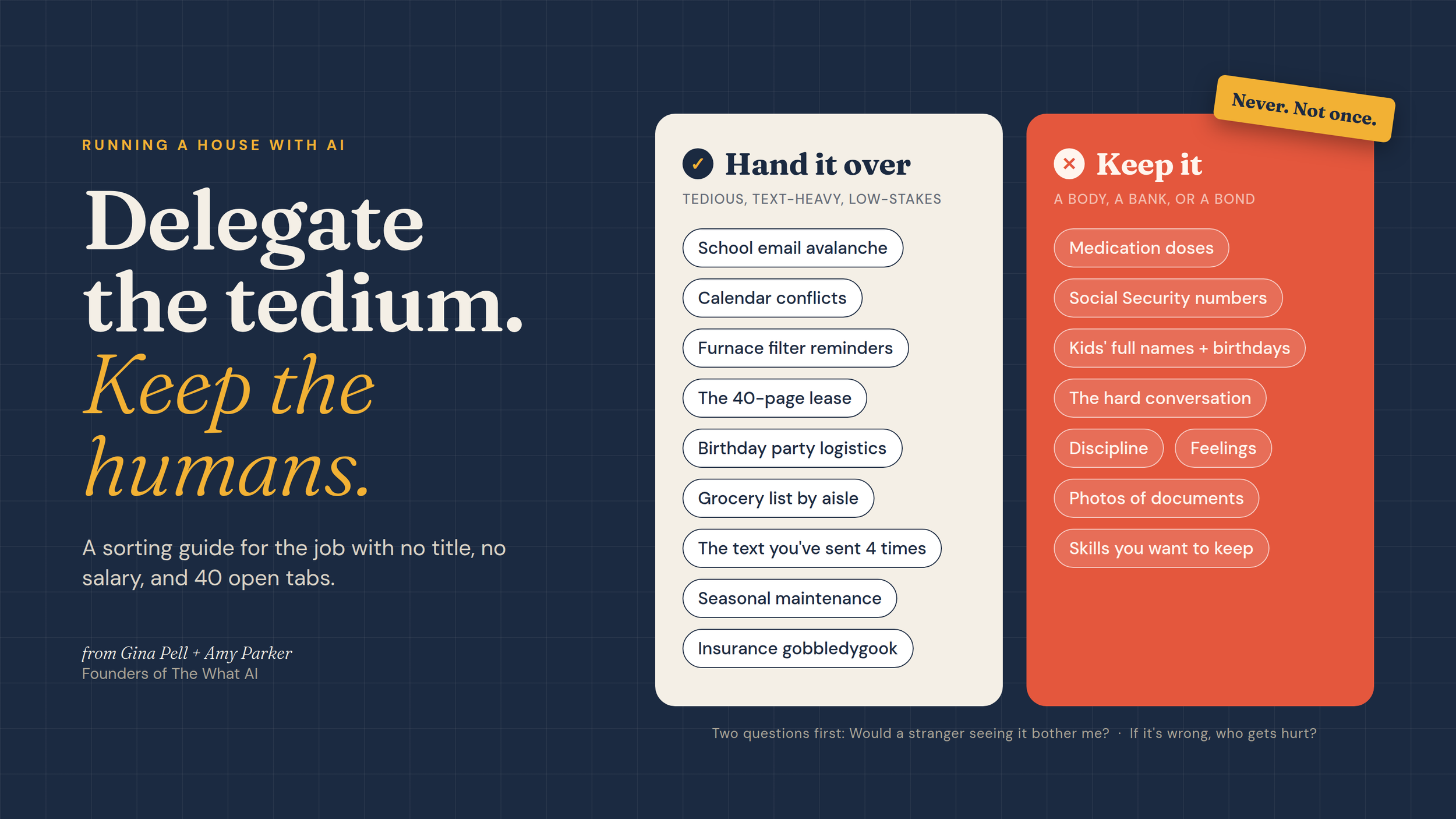
AI is superb at anything that is tedious, text-heavy, and low-stakes if it gets a detail wrong. It is terrible at anything that requires judgment about people you love, or facts that matter if they're wrong. Sort your household accordingly.
The Inbox. The school sends 11 emails a week. The camp sends six. The HOA sends one that is somehow 4,000 words. Paste them all into a chatbot and ask for a single list of dates, deadlines, and anything that requires a reply from you. This is the highest return on five minutes we've found. Amy does it every Sunday night and hasn't missed a picture day since.
The Calendar Detective. Give it your family's recurring commitments and ask it to find the conflicts before they find you. "Soccer is Tuesdays and Thursdays at 4:30, piano is Thursdays at 5, Dad travels the second week of every month, when does this fall apart?" It will tell you. Then it will propose three alternatives. You pick.
The Maintenance Memory. Every house has a running list nobody keeps. Furnace filter, gutters, smoke detector batteries, the dryer vent you've been meaning to clean since 2023. Tell AI what you own and where you live and ask for a seasonal checklist with reminders you can drop into your calendar.
The Translator. Insurance explanation of benefits. The 40-page lease renewal. The letter from the school district. Paste it in, ask "what does this actually say and what do I need to do," and get a plain-language summary. Then (this part matters) read the original for anything involving money or signatures.
The Party Planner. Let AI plan your next birthday party, 12 kids, one backyard, budget of $200, mother who refuses to make a cake shaped like anything. It will give you a timeline, a shopping list, three games, and a nicer way to say "no gifts."
The Meal Planner. You know this one. We wrote about it last week. Pantry inventory in, week of dinners out, grocery list sorted by aisle. We wrote a whole piece on it. This is the easiest way to dive in to AI if you’ve never used it before.
The Gentle Nag. Ask it to draft the text to your partner about the thing you've asked about four times. Ask it to make the tone neutral. This is not avoidance, it's diplomacy. (Avoidance is further down. We'll get there.)
The common thread: you are giving it information you already have and asking it to organize, summarize, draft, or remind. It is a very fast, very tireless assistant with no memory of what happened last week and no idea whether your kid is actually allergic to peanuts. Which brings us to the other list.
What you should never, ever use it for
We don't say "never" lightly. We are the people who told you to lean in and learn this stuff. But there are a handful of household jobs where the downside of a wrong answer is so much bigger than the upside of a fast one that the math simply doesn't work.
Medication and dosing. Not for your kids, not for your parents, not for the dog. A randomized trial published in Nature Medicine this year had nearly 1,300 people work through medical scenarios with a chatbot and found they did no better than people using a plain old search engine. Use AI to organize a med schedule someone else prescribed. Never use it to decide the schedule.
Anything with a Social Security number, account number, or your child's full name and birthday attached. A blanket rule: if you wouldn't post it on a community bulletin board, don't paste it into a chatbot. That includes photos of documents, photos of your kids' faces attached to identifying details, and the login to the family Netflix account (yes, people do this).
The hard conversation. The talk with your teenager about the thing you found. The conversation with your mother about her driving. The one with your partner about the 67 percent. AI can help you prepare, but don’t let it write the script for you.
Discipline and emotional guidance for your kids. A model trained on the internet has read every parenting book and raised zero children. Use it for the birthday party. Not for the meltdown. Instead, you might want to try Rosalie, an AI assistant trained on the trusted work of child psychologist Dr. Lisa Damour (Untangled, The Emotional Lives of Parents).
How to think about it
We've said it before and it bears repeating: opting out of AI doesn't stop it from being built. It just means it gets built without the people who actually run households having a say in what "helpful" looks like. The trick to running a household with AI is the same as running anything with AI: it's an assistant, not an authority.
These are the habits we're building with THE WHAT AI, our new Web App that teaches regular, non-technical people to use AI on their lunch break, with practical lessons sourced from credible creators around the Web.