
Declutter Your Home With AI
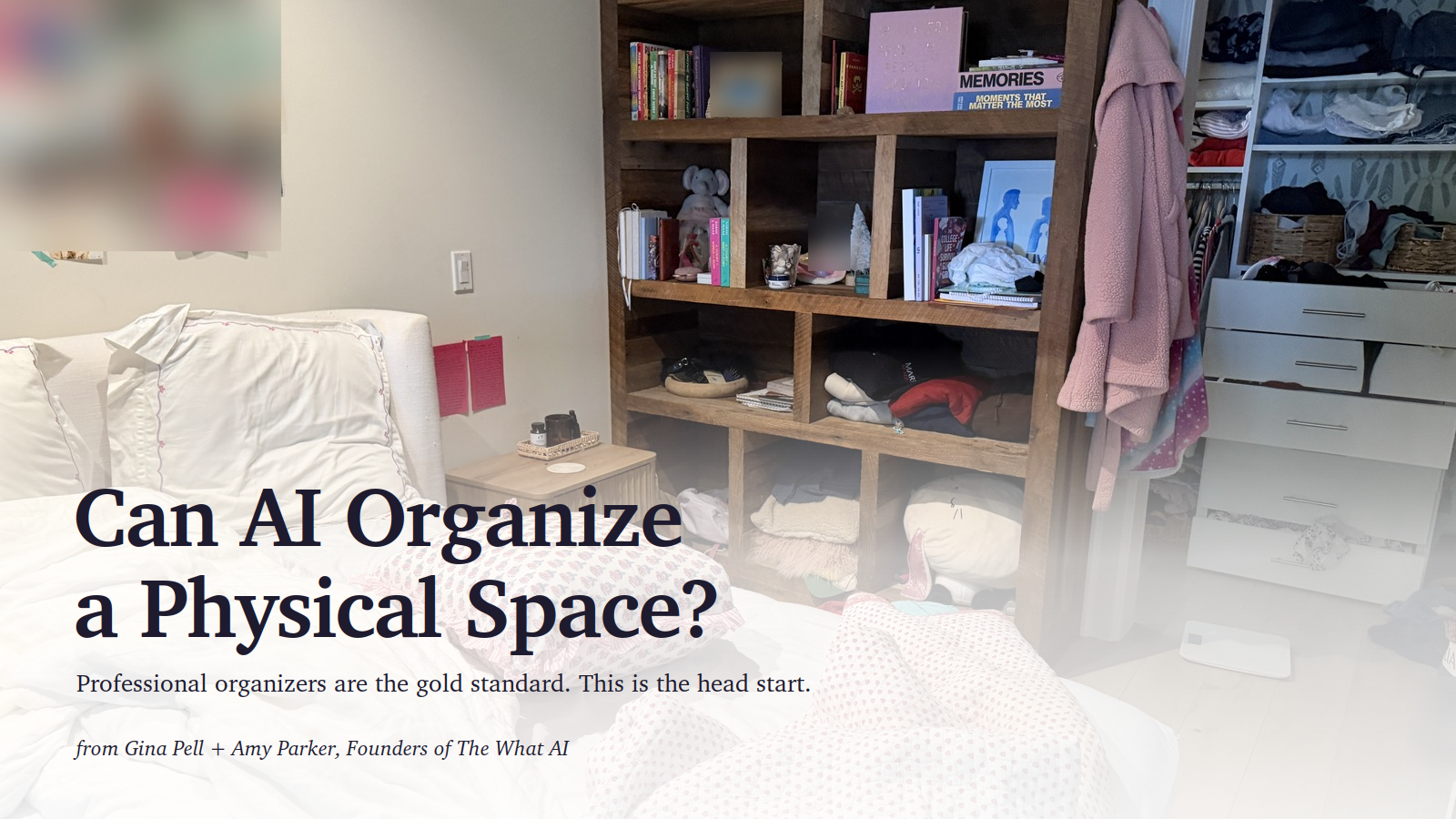
Professional organizers are the gold standard, a rare breed whose hyper-efficient brains work differently than our maximalist-leaning proclivities. If you can afford one, why wouldn't you hire a BOSS to finally get the kitchen in logical order or, god forbid, your infamous closet?
If a pro isn't in the cards, Claude, Gemini, or ChatGPT can get the ball rolling. It can't guess which mugs matter most, and it will never diplomatically inform you that your poker playing dog poster is passé. But there are five jobs where it'll give you a real head start.
FIVE WAYS AI CAN HELP YOU ORGANIZE
1. It can see the whole house at once.
You've walked past that messy bookshelf a hundred times. A photo hasn't. Take one wide shot of every space that isn't working, drop them all into one chat, and ask it to do what an organizer does on the first visit: rank, diagnose, sequence.
These are every space in my house that isn't working. Household: [2 adults, 1 teen, 2 dogs]. I can give this [2 hours a weekend]. Rank the spaces by which fix improves daily life most, tell me what's causing the clutter in each (no home for it, too much of it, or wrong storage), estimate the time each will take, and tell me what to do this Saturday.
What you get is a plan with an order. Most people never get this far on their own, and it's the reason the pile is still there.
2. It can count your stuff.
This is the underrated one. Take a picture of your pantry, a drawer, a garage wall, and it will inventory what it sees and flag the duplicates: four tape measures, three half-used sunscreens, two identical bags of rice. You didn't notice that. Now you do, and half the decluttering just made itself.
Inventory everything in this photo by category. Flag duplicates, anything likely expired, and anything that doesn't belong in this space.
Works best on pantries, bathrooms, bookshelves, junk drawers, tool areas, kids' rooms. Works worst on a closet where everything's hanging in a row (it can't tell your black sweaters apart, and honestly, can you?).
3. It can help you decide what makes the cut.
Decluttering is hard because every object has a story. A chatbot has no memory of what you paid and no opinion about who you were in 2013. Apartment Therapy's Rose Morrison used the 90/90 Rule, describing one item at a time and asking a neutral question, and cleared 23 pieces she'd been circling for months. Hand it your rules, then hold up the thing you're stuck on.
My rules: not used in a year, it goes / doesn't fit today, it goes / wouldn't buy it again, it goes. I'm holding [a bread machine I used twice]. Apply my rules and ask me one question if you need to. No guilt.
It won't decide for you. It stops the "just in case" reflex, which is all you need.
4. It does the math on what fits.
The most common organizing mistake is buying the bins first. Give it the measurements of the actual shelf and the actual pile, and it will tell you what size and how many, before you spend anything.
This shelf is [30 inches wide, 14 deep, 12 tall]. Here's a photo of what needs to live on it. Tell me how to arrange it using what I own, and if I need containers, give me the exact dimensions and count. Budget [$40].
It's also good at the thing nobody enjoys: figuring out where things should live based on how often you use them. Daily at eye level, weekly below, yearly up high or in the garage.
5. It handles where most projects die in the hallway.
The Donate pile sits by the door for six weeks because nobody wants to figure out the logistics. That is a text problem, and text problems are its whole life.
Here's everything leaving the house. Tell me what's worth selling and where, write a short listing for each, find a charity near [your city] that picks up, and tell me where to take the paint, the old laptop, the mattress, and the expired medication.
Ten minutes, and the pile has somewhere to go.
WHERE IT'S NOT USEFUL
Sentimental items. It will tell you to keep the letters. You knew that.
Depth and scale. It reads a photo, not a room. Measure things yourself.
Real product recommendations. That's what reviews and the organizers' Instagrams are for.
If nothing can go. A chatbot will cheerfully validate keeping all of it, which is why you need a friend or professional to run it by.
Anything with a document in the frame. Keep passports, checkbooks, and pill bottles off camera.
This is the kind of practical, no-hype AI use we're building THE WHAT AI to teach.
Get on the list →